 Save this storySave this story
Humans have an inherent proclivity toward forbidden fruit. Late party nights ahead of early days, that gratuitous last pour of wine, toxic situationships you know will never go anywhere. It’s hard to resist finding relief in guilty pleasures, even ones we know to be actively detrimental. That especially goes for cigarettes, which have made a bona fide comeback in popular culture—and their appearance in the beauty space is rising from an occasional cameo to a prominent force.
Recent product launches are rife with smoking symbolism, both blatant and subtle, intentional and seemingly not. Late last year, m.ph launched slender lipsticks called Lip Ciggies, which the brand marketed as “hard to quit.” Glossier’s latest holiday collection included a limited-edition Zippo lighter (the sole intended use for which, the brand tells Allure, is lighting its candles; Glossier also states that it does not condone smoking). L’Objet quickly sold out of its recent Smoking Lips incense and fragrance set, and the same goes for designer Rick Owens’ collaborative oral care collection with Selahatin, which was inspired in part by his smoking habit. Cigarette-inspired lipstick cases are currently going viral on TikTok Shop; they feature an image of Lana Del Rey above a faux health advisory label that reads: “Smoking kills, but we were born to die anyway,” a reference to her 2012 song. (Allure contacted representatives for m.ph and L’Objet for comment on their respective products and did not receive a response by the time of publication.)
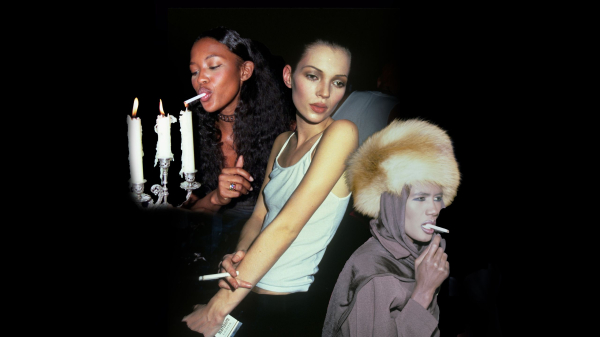
It’s not just the products; the aesthetic of smoking itself is also on the rise. Smoking-related searches have spiked on Pinterest. On TikTok, you might have seen videos people getting their hands on the sleek packs of Vogue cigarettes (not affiliated with the fashion magazine, by the way) on European trips, or niche fragrance and makeup moments that wink knowingly at the taboo. Valentino Beauty’s Studio 54-themed fashion week party included cigarette girls–though the cigarettes on their trays were candy, alongside fragrance samples (New York City’s 2002 indoor smoking ban still stands). At the spring 2026 shows, at least three designers featured models smoking as they strutted down the runway. It’s a direct pushback to the overly sanitized “clean girl” ideal. If you think that instinct feels reactionary, then you’d be right. And it was bound to happen eventually.
“It’s a direct pushback to the overly sanitized “clean girl” ideal. And it was bound to happen eventually.”
In beauty, everything moves by pendulum swing. One moment, we recoil at the idea of altering our appearance a certain way—remember when we all plucked our eyebrows razor-thin?—or indulging in a dubiously safe wellness fad, only for those same behaviors to become so pervasive they feel second nature or even aspirational. Whether by whim or at the behest of a viral social media moment, the trend du jour is often one that existed in the past and was simply rewritten overnight. It’s within this constant churn of ideals and contradictions that cigarettes are now being recontextualized.
Think of any 1920s flapper, smoldering ’60s vixen, or Cosmo-clutching ‘90s Manhattanite: she’ll likely have a cigarette hanging from her lips or balanced between her fingers. It’s an oddly eternal image that has circulated endlessly across decades of cultural ephemera. It’s elegance. It’s sleaze. It’s gross. It’s natural. It’s highbrow or lowbrow, depending on the poison you pick (or, rather, the narrative rationalization you ascribe to it). It’s also, of course, absolutely terrible for your body in every conceivable way.
We’re no longer in an era of ignorant bliss or naive nonchalance around the dangers of cigarettes (which were once widely advertised as being good for our health). Despite a collective understanding of the consequences—smoking kills, after all—it’s not as though anyone ever truly stopped. Even as traditional cigarettes fell out of favor throughout the past two decades—only 1.4 percent of teenagers today report cigarette use, according to the FDA—nicotine use itself has persisted, shapeshifting into vapes, patches, and ZYN pouches, each with youth-forward aesthetics of their own, if not the same cultural romance. If anything, cigarettes take it a step further; offering a tactile respite that counters the plastic rigidity of vapes.
“It’s elegance. It’s sleaze. It’s gross. It’s natural. It’s also, of course, absolutely terrible for your body in every conceivable way.”
Still, the consequences are real. “Smoking is never in style—we aren’t talking skinny jeans or bell bottoms,” says board-certified dermatologist Mona Gohara, MD. “We’re talking carcinogens, which are never cute.” And, far short of cancer, yellowed teeth and nails, she says, are just the beginning of the aesthetic consequences; smoking severely impacts skin health and appearance, accelerating collagen and elastin breakdown, deepening wrinkles around the mouth and eyes, dulling skin tone, thinning hair, and restricting blood flow that delivers oxygen and nutrients to skin cells. Briefly set aside during a smoke break, these indisputable truths stand in stark contrast to our collective obsession with the perfectly smooth and “snatched” look, sustained by the proliferation of wrinkle-reducing injectable procedures and facelifts.
Even as we continue to indulge a harmful habit that makes us, for lack of a better term, uglier, people won’t kick the habit—or at least stop aestheticizing it. Which, I won’t lie, I understand. There’s something about a cigarette in the right kind of ambience that functions as a sort of aesthetic appendage. A rouge-smudged butt or sparking up with both hands is visually evocative, like peering over a mysterious pair of shades or flipping open a compact. Some Gen Xers today look back fondly at the days when they would light up a cigarette when they needed an escape or a distraction to kill dead time—today they light up their iPhones and start doomscrolling.
But beyond aesthetics, the newfound pervasiveness of cigarettes only makes more sense when you take a step back and look at the bigger cultural picture. In an era where GLP-1 drugs are increasingly framed as a get-skinny-quick scheme—one many find irresistible despite mounting concerns about long-term effects—the return of cigarettes feels less accidental. The hyperfixation around wellness has splintered into a whole spectrum of archetypes—from Pilates princesses to “that girl” (whoever she is) and everything in between—and cigarettes sit on its the ever-growing fringes. They function as a kind of cultural foil of indulgent destruction, a release of the burden of constantly striving for perfection, or at least keeping up that appearance.
"That people would lean into something unabashedly detrimental feels perversely inevitable."
On that note, it’s hard to ignore the growing nihilism that our current political climate—and environmental climate, for that matter—is igniting. In 2025, roughly one in four adults under 30 report experiencing depression, a rate that has more than doubled since 2017, according to Gallup. We’re conditioning ourselves to live with the ubiquitous sense of doom, and in the face of global disorder and disarray, a cigarette posits itself as harmless in comparison.
In a cultural milieu burnt out on manufactured physical perfection, smoking becomes the resistant counterpart to relentless optimization—something gritty to cut through the gloss, something real that grounds in space and time. That people would lean into the allure of something unabashedly detrimental feels perversely inevitable. Whether that’s a decisive algorithmic shift or a lasting, culturally-informed habit is yet to be seen, or rather, consumed.